
World Economy sleepwalking to another financial crises is quite a hot topic these days. Quite recently Mervyn King who was governor of Bank of England during the 2008 financial crises gave a speech in the semiannual meeting of the International Monetary Fund where he highlighted this issue.
I listened to his speech and he very rightly pointed out that by sticking to the new orthodoxy of the monetary policy and pretending that we have made the banking system safe and sound by introducing regulatory acts and laws we are sleepwalking towards the crises. It is predicted that the world will endure an extended period of low growth with ineffective ultra-low interest rates and infact the process has started already. Moreover, following the Great Inflation, the Great Stability, and the Great Recession, we have now entered the period of Great Stagnation.
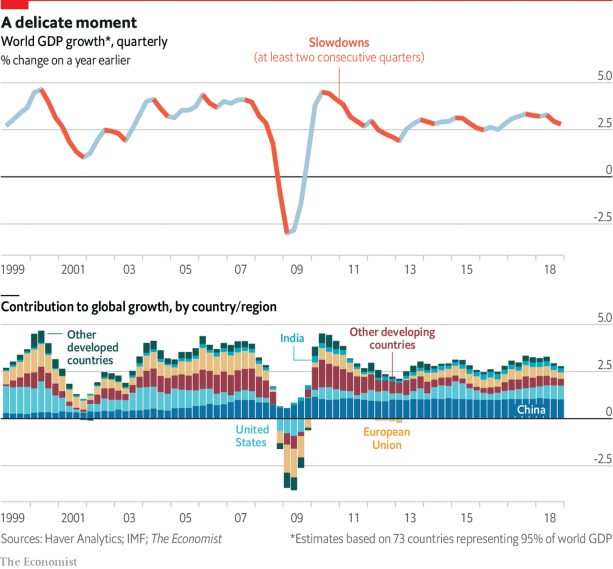
There is no denying the fact that combating another financial crises would not be easy as the world already is experiencing a synchronized growth slowdown. The world is in a low growth trap for now and this can be validated by taking into account the performance of major economies. Quoting the example of China, its economy has grown by 6% in the third quarter of this year, its slowest pace in last 30 years. In addition to this, the German economy shrank by 0.1% in the second quarter and a contraction is expected in the third and fourth quarter as well placing its economy in a technical recession.
Main reasons for this slowdown in the world economy being the trade war between America and China, slowing manufacturing and shrinking investment opportunities. Furthermore, riots in Hong Kong, problems in key emerging countries such as Argentina and Turkey, growing tensions between France and Germany over the future direction of Euro and the increasingly bitter political conflict in the US. Also, not to ignore the ongoing tensions between Arab-foes which again are leading to slow world economic growth.
To conclude, prevailing trade tensions, policy uncertainty, and geopolitical risks will have to be resolved by all stakeholders who are shaping world economy. Also, it is now time for the US Federal Reserve and other central banks to initiate talks with politicians behind closed doors to make legislators aware of how vulnerable they would be in another crisis.
Period.

 fajarkhansblog