
Before discussing my own behavior in today’s consumer culture it is pertinent to explain how our society reached the point where we stand now. Consumerism is a phenomenon or a concept where the economy is aggressively directed at selling and spending of consumer goods. The idea is to extract as much revenues from the consumer money as possible. With this agenda in mind, business companies focus on all the segments of the society, especially the middle and upper class, and devise new spells that would attract a common individual to something that is normally not a need but becomes a want for him. This typical behavior is attributed to the capitalistic organizations that were criticized by Karl Marx and were said to hold immense collection of ‘commodities’. Marx rightly criticized this culture on the grounds that these companies when they hold the power of controlling a society’s psyche, give rise to a capitalistic environment that is solely based on greed and selfishness. For launching “wants”, the manufacturers and their marketers devised an environment where each product was assigned a brand name and this name became more appealing than the actual specifications of the product. This new atmosphere came to be known as a consumer culture, where great emphasis was put on lifestyle and where availability of materials and these branded products became the determinants of happiness and satisfaction. As argued by the theory’s proponents, consumer culture no doubt increased people’s spending and thus contributed to the economy’s well-being to some extent, but then it also had horrifying implications as well. The very core of the agenda in favor of consumerism highlighted products and materials as the most important must haves, sidelining the importance of morals or values or even other human beings. When happiness got tied to material possessions, it also encouraged people to spend more than their capability. It was this environment that also led to wide usage of consumer credit cards, and in the end completely handicapped the common individual.
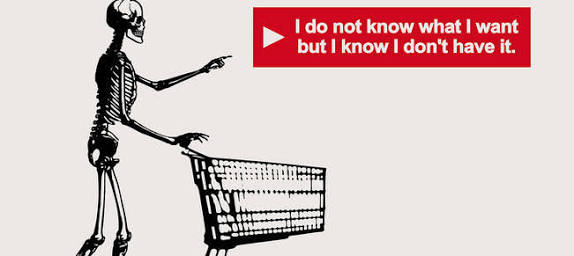
So where do I stand on this timeline of consumer culture? Today when I look around me I see an environment where every other person is struggling to have more. This craving for more is majorly directed at products that are represented by ‘impressive’ brands. This has made one element supersede all other reasons that lead to purchasing. I.e. to stay in trend. By saying this I do not completely negate the existence of brands. I believe that brands should only be followed on the basis of the promise they make and the need they fulfill. They should be followed on rational patterns of decision-making, and products should be the center of focus rather than the brands. Such a practice would result in vigilant consumption by minimizing unnecessary purchasing and thus would completely eliminate the evils of impulse buying. In my case, if ‘Sufi’ promises to provide me with clear and hygienic water, on the grounds that I have my faith in the brand, I would never specify nestle just for the sake of setting up an impression.
Our society today stands at such a miserable stage where peoples’ personalities are being judged on the basis of brands that they consume. The situation has become so pitiable that personality tests have started analyzing people on their preference for either Pepsi or Coca-Cola. This is alarming for a person like me, who never cares about the brand as long as the quality and purpose are fulfilled. My attitude is not completely indifferent to brands around me; I believe that brands, if marketed ethically, portray a picture of the products that they represent. This can give us an idea about the specifications and thus can assist us in making sensible decisions.

Every purchasing decision that we make usually involves external influencing factors that either encourage the product buying process or restrict it. The most widely involved factors, in our society, normally include family, culture and morals. Societies having weak links to their own cultures tend to easily adapt to new behavior patterns introduced by brands. Such societies can easily be manipulated to spend more on unnecessary purchasing. In my situation if the “trendy” ripped and faded jeans are not acceptable in my cultural norms and if my family holds a negative view of them I would not be spending money on these. Likewise, same factors also play their roles in encouraging purchases of specific brands or products. My preference for environment friendly cosmetic products leads me to ‘body shop’ and its product offerings. Body shop uses organic ingredients in all of its products, ensuring product purity. The thing that I like the most about the brand and the reason that I always prefer it over others, is that it strongly condemns animal testing.
I also believe that in a world where marketers are doing whatever they can to manipulate consumers there are pressure groups and organizations that are revealing the unethical marketing practices done by many businesses. A very good example in this context is that of Peta (People for the Ethical Treatment of Animals) organization that is revealing the darker side of many well-known clothing and cosmetic brands that are exploiting animal rights by using them for their own purposes. I recently watched a video that was uploaded on Peta’s official page showing how the wool industry savagely sheered sheep skin and then distributed it among many clothing brands. Also, in the year 2014 L’Oreal and Victoria’s secret were charged guilty of testing their products on animals. This awareness made me realize that its not just the brand name that one has to look at when it comes to buying a product but the product itself along with many other things.
Being a student of marketing I have to keep myself updated regarding the different market trends, marketing campaigns, brand activations etc. Although there are certain brand advertisements that I like but that does not necessarily mean that I would buy from those specific brands. Before purchasing any product or service there are a lot of things that I have to take into account like its price, quality, convenience, acceptance by my family and society etc. So at the end of the day my purchasing decisions would be different from others as all consumers have their own perceptions, which are directed by a large number of internal as well as external factors.

 fajarkhansblog